Interdisciplinary installation

Tapestry, Soap and Blood Bath

Empire. Violence. Complicity.

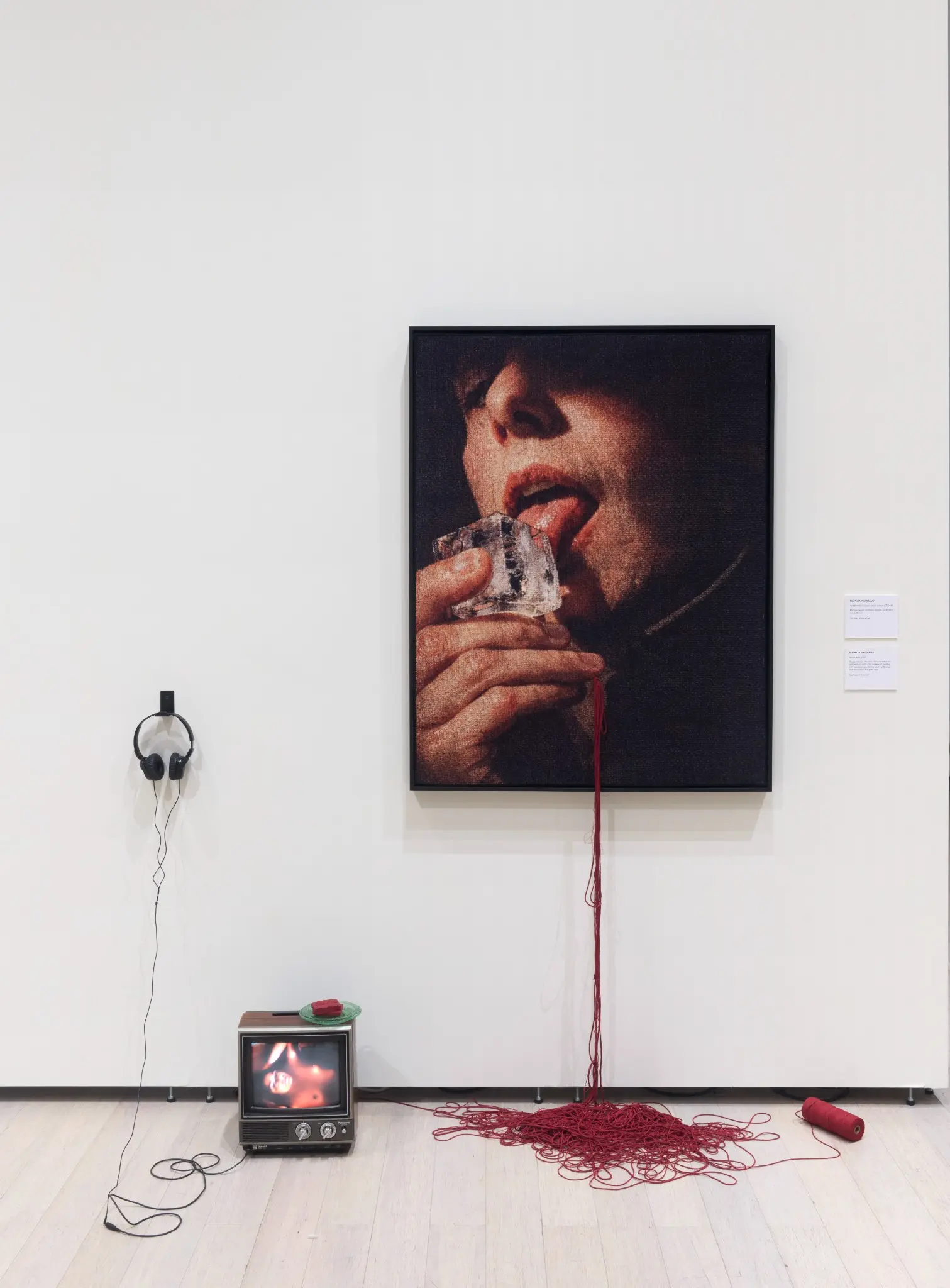
Installation view with Self-Portrait of Queer Latina Licking ICE, a CRT television playing Blood Bath, red soap, red thread and headphones
Installation view

Self-Portrait of Queer Latina Licking ICE

Artist
Natalia Neuhaus
Rug provenance
India

This piece—an outsourced rug made to look and feel like a tapestry—reflects the contradictions and failures built into protest itself. Although conceived as a gesture of resistance, its production was unknowingly outsourced to a manufacturer in India, implicating the work in the very systems it seeks to critique.

This contradiction finds an echo in the Ouroboros—a snake that eats its own tail, an ancient symbol of eternal return and cyclical repetition. Cause and consequence entrenched in a never-ending cycle.

The “American dream” was achieved through intervention abroad, particularly in Latin America from the 1950s through the 1980s. These actions disrupted political and economic life, contributing to instability, inflicting trauma and displacement across generations. With violence compounded by poverty—and now climate change—many migrants from Latin America flee the fallout of these interventions, ironically seeking refuge in the nation that helped set them in motion.

When these historical factors go unacknowledged in public narratives and policy, the resulting migration is often framed as detached from its deeper causes, reinforcing harm rather than addressing it. Against this backdrop, deportation functions as an inhumane response to problems with deep historical roots. Deportation violence is not new; it is structural, rehearsed, and bipartisan.
Handmade Red Goat’s Milk Soap: Notes on Complicity

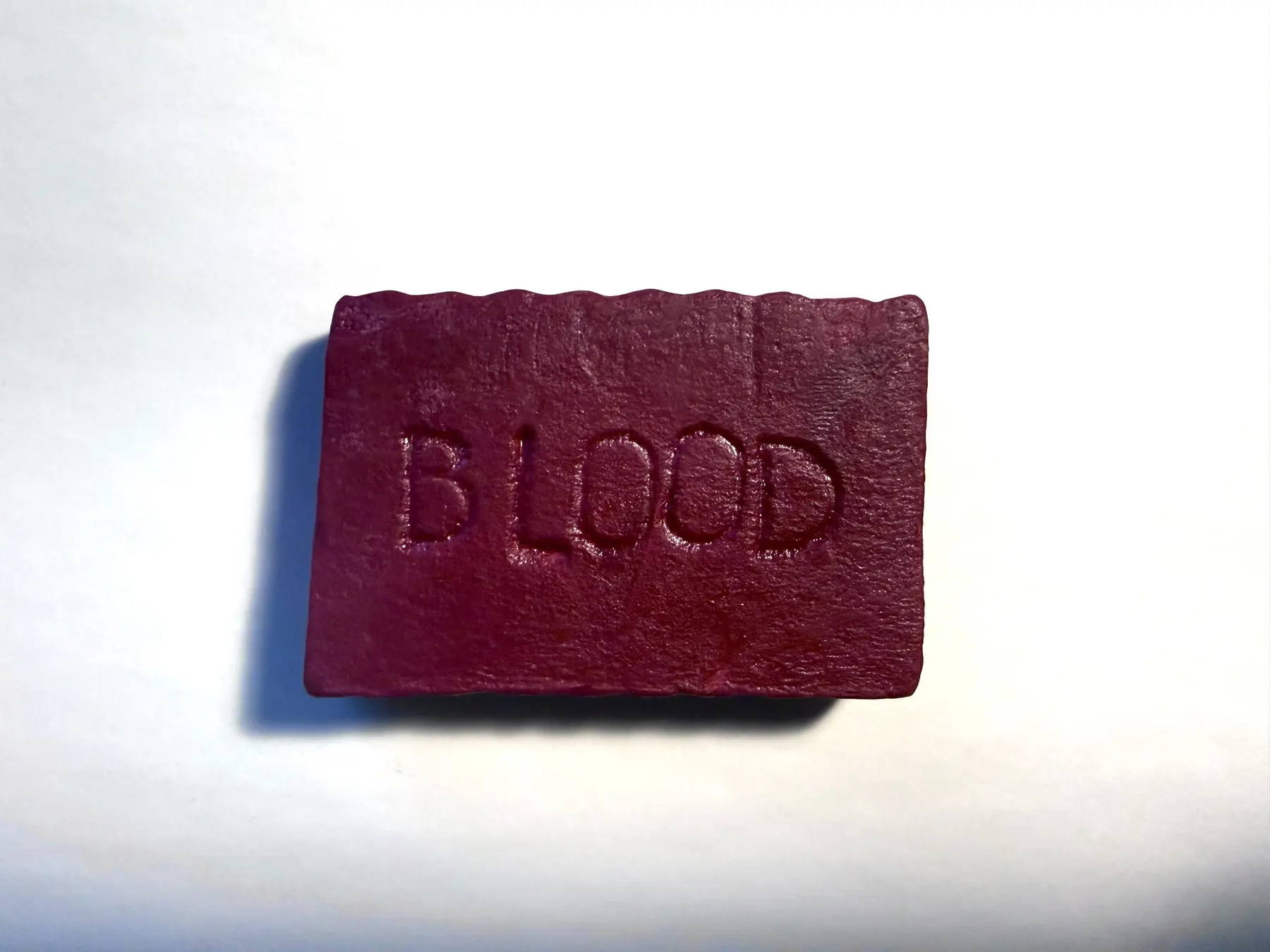
A handmade dark-red bar of goat’s milk soap embossed with the word BLOOD

“These violent delights have violent ends
And in their triumph die, like fire and powder,
Which, as they kiss, consume.”

—William Shakespeare, Romeo and Juliet

It is day for some, night for others, and the news of yet another conflict in the making seeps into my skin. Nothing I do—or refuse to do—can distract me from the feeling that we, as a collective, have no control, no agency over the war games of a few, and yet “we” remain indirectly complicit.

I feel a strange urgency to make soap, as though it might cleanse that feeling of complicity.

Deliberately, I chose a pre-made goat’s milk soap solution. Perhaps it is my Catholic upbringing seeping into my queer body. In the haste of seeking absolution, I forget its provenance. Shipped from somewhere else, it folds me further into the slow violence of climate change. You see—complicit. There is no way out, only the ritual of protest: an act of mea culpa, after which, once absolved, our crimes are all but magically erased.

I, too, bought red dye—another deliberate gesture in the aesthetics of complicity.

Heat in the microwave on high for 1 minute, then continue heating in 10-second intervals until fully melted and smooth. Pour into a bowl, then add coloring until you reach the desired shade. I simply followed the instructions, you see. For an hour, I kept adding red dye and stirring. Slowly—so painfully slow that it became a cathartic performance in itself—what began as white, pre-made goat’s milk soap turned pink, and then, at last, red. Three empty bottles of red dye later, the mixture is so red that my stovetop is transformed into a bloodbath of soapy goat’s milk stains.

“Fuck,” I say, because this is not my home. I do not own it, and in a year or so I will likely be forced to move. Never mind, I tell myself. I hate my landlord.

Is the red dye natural? Does it matter when all of this is part of an even larger scheme? I stare down at the stovetop, where circles and drops of red ink have become unwanted residents. Then I look at my hands, covered in red polka-dot stains. The red, pre-made soap has now hardened, and I use the culprit of this crime to wash away the evidence from my hands.

Blood Bath

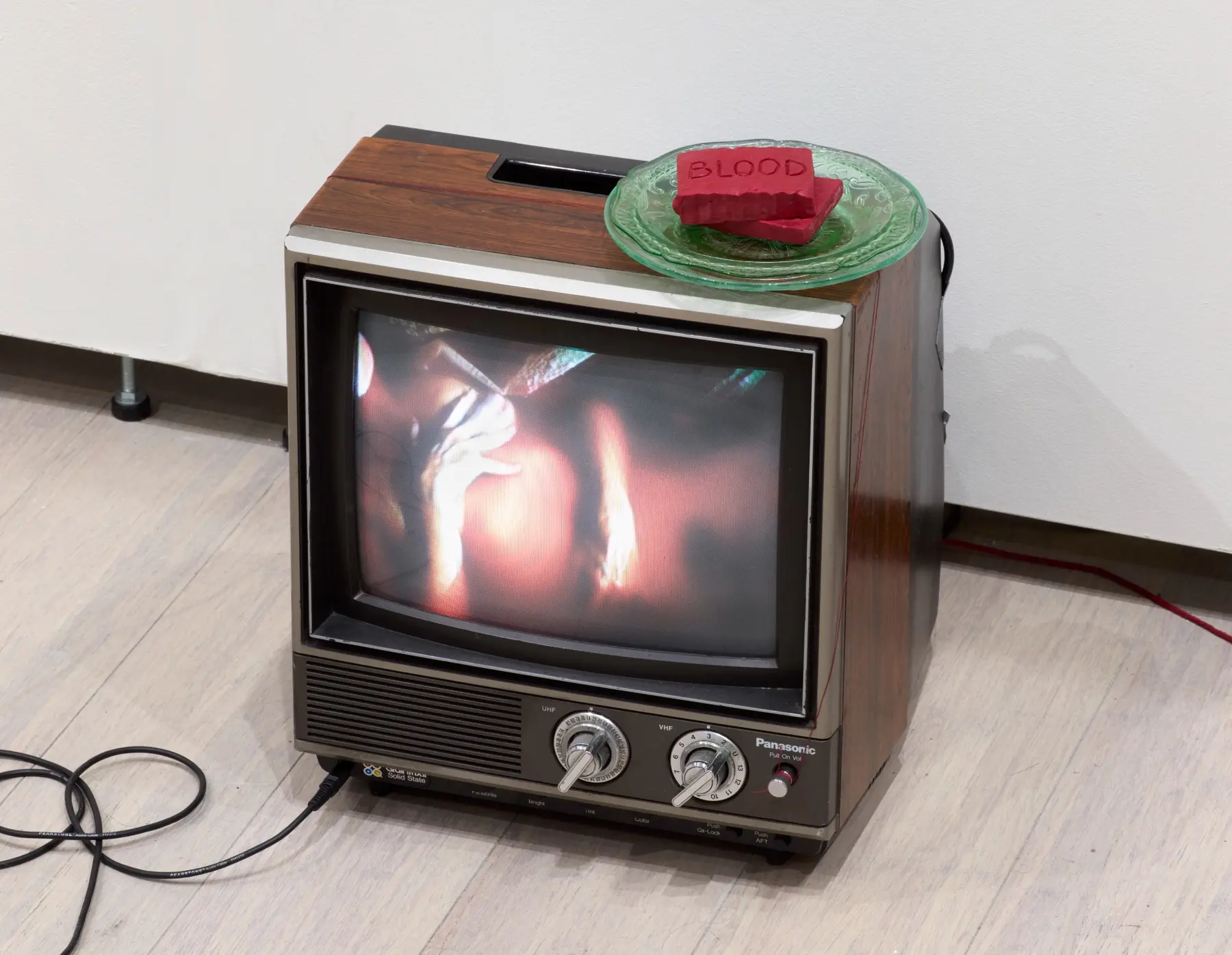
A vintage CRT television playing Blood Bath with two red bars of soap on a green glass plate

Video and performance

A faint smell of cleanliness lingers on my skin—post-bath, post-performance, post-ritual—as if in search of redemption for crimes committed by others, crimes to which I am nonetheless indirectly complicit. What began as an unconscious response to the news of yet another war first took shape as an object—in this case, a pre-made goat’s milk soap later transformed by hand into a red bar—but gradually became something else. The alteration of the soap, and then the soap itself, dissolved into an ephemeral performance whose final form is not an object at all, but its disappearance.

If order cannot mend brokenness, perhaps dilution—and the spent chaos of entropy—might give rise to a new order. If entropy transforms from within, dilution transforms from without: a quieter, nonviolent undoing. Unlike Jack Halberstam’s Unworlding, in which the world burns and collapses so that another order may rise from its ashes, dilution works by softening, thinning, and dissolving from the outside in. The dissolving of the soap in warm water stages this logic materially, not as rupture but as dispersal, softening, and release. This process finds a semiotic parallel in the reclamation of terms such as queer, dyke, and faggot: through repetition and resignification by the communities they were once used to wound, their violence is diluted and new forms of collective identification emerge.

Read moreRead less

The pre-made goat’s milk soap, reworked by hand with red dye, bleeds into the warm bathwater, staining it as the performance is documented as evidence of our collective participation in capitalist violence. Twice denied full existence—first as a woman, then as a lesbian—this body, too, carries violence in and on itself, turning embodiment into a medium of protest. Like a double negative, its refusal does not cancel itself out but intensifies. Yet the work remains entangled in the systems it critiques: a pre-made goat’s milk soap imported from elsewhere, red dye, and the expenditure of resources—electricity and water—to produce something banal and unnecessary: an artistic performance.

Oscillating between deep breaths and soft focus, the scene shifts between intimacy and unease. The artist’s naked body operates as a device of attention: just as viewers struggle to look away from images of violence, the body turns looking into voyeuristic complicity. Conditioned to read certain female bodies as available, erotic, and consumable, the audience is implicated in the act of looking itself. The work redirects that gaze, exposing looking as a performative act through which bodies are made socially intelligible. Echoing Judith Butler’s Performative Acts and Gender Constitution, the body here is not a neutral fact, but something produced through the repeated norms that organize and categorize gender—a construct that has historically restricted certain bodies by rendering them legible only through eroticization, control, and consumption.

In Blood Bath, the performative body does not reject this established construct; rather, it turns it against itself, mobilizing it as a means of protesting our collective complicity in the violences of the modern world.